The Paradox of Choice: Why Netflix’s Algorithms Leave Viewers Underwhelmed
As Netflix looks to integrate generative AI to help subscribers navigate its vast library, the streaming giant faces renewed scrutiny over whether its recommendation engine is actually alienating audiences.

Netflix is testing new AI tools to help users find relevant content faster
Netflix recently disclosed plans to deploy generative AI to help users locate relevant programming more quickly across its massive content catalog. However, the move has reignited a long-standing debate: is Netflix's own recommendation algorithm responsible for making viewers feel like there is increasingly "nothing to watch"?
Speaking on June 3 at the Bloomberg Tech conference in San Francisco, Elizabeth Stone, Netflix’s Chief Technology and Product Officer, stated that the company is currently trialing several emerging technologies, including generative AI, natural language processing, and voice-controlled interfaces.
According to Stone, the ultimate objective is to guide users through severe "content fatigue" when confronted with thousands of movies and television shows. The envisioned system will synthesize viewing histories, individual preferences, trending metrics, and natural language prompts to pinpoint exactly what a user wants to watch at any given moment.
"There is simply too much content out there. How do I discover what is right for me, and specifically what is right for me right now?" Stone questioned.
However, many industry analysts argue that users' growing difficulty in finding compelling content on Netflix is the direct byproduct of the core recommendation model the streaming platform has built and relied upon for years.
The Retention Trap: Prioritizing Watch Time Over Artistic Merit
Netflix has long been hailed as a pioneer in leveraging data to personalize the digital entertainment experience. Every title that populates a subscriber's homepage is the byproduct of intricate computations analyzing viewing history, watch duration, search behavior, and user habits.

Netflix's recommendation system is built on user behavior data, from viewing history to trending content, to maximize audience retention
However, an analysis by The Guardian suggests that this proprietary algorithm is fundamentally not designed to identify artistically outstanding works. Instead, its primary optimization goal is to surface content with the highest probability of maximizing viewer retention.
This algorithmic bias yields a conspicuous consequence: accessible, low-risk films that adhere to predictable formulas and cater to mainstream tastes are systematically prioritized over experimental cinema or auteur-driven projects.
Bela Bajaria, Netflix’s Chief Content Officer, has famously referred to this as a "gourmet cheeseburger" strategy—crafting premium yet commercially engineered products designed to satisfy the broadest possible audience, rather than catering to a niche demographic with specialized cinematic tastes.
Data compiled by industry analyst Stephen Follows underscores this homogenization, revealing that a mere 7% of the top-performing titles on Netflix command a staggering 50% of the platform's total viewership. This concentration of consumption is notably more dense than that of the traditional theatrical market.
Critics warn that by continuously feeding users a loop of content mirroring their past behavior, the algorithm effectively "flattens" cultural tastes. Consequently, audiences are left with a growing perception that Netflix originals are increasingly interchangeable—effortless to consume, but ultimately forgettable.
Will Generative AI Solve the Quality Dilemma?
Against this backdrop, Netflix views generative AI as the logical evolution of its recommendation ecosystem. Rather than relying solely on historical viewing metrics, advanced models can interpret more sophisticated and nuanced requests, such as "I want to watch a lighthearted movie after work" or "a show like Stranger Things but less scary." This technology is expected to dramatically streamline the search process and significantly improve a user's probability of discovering relevant titles within the platform's sprawling catalog.
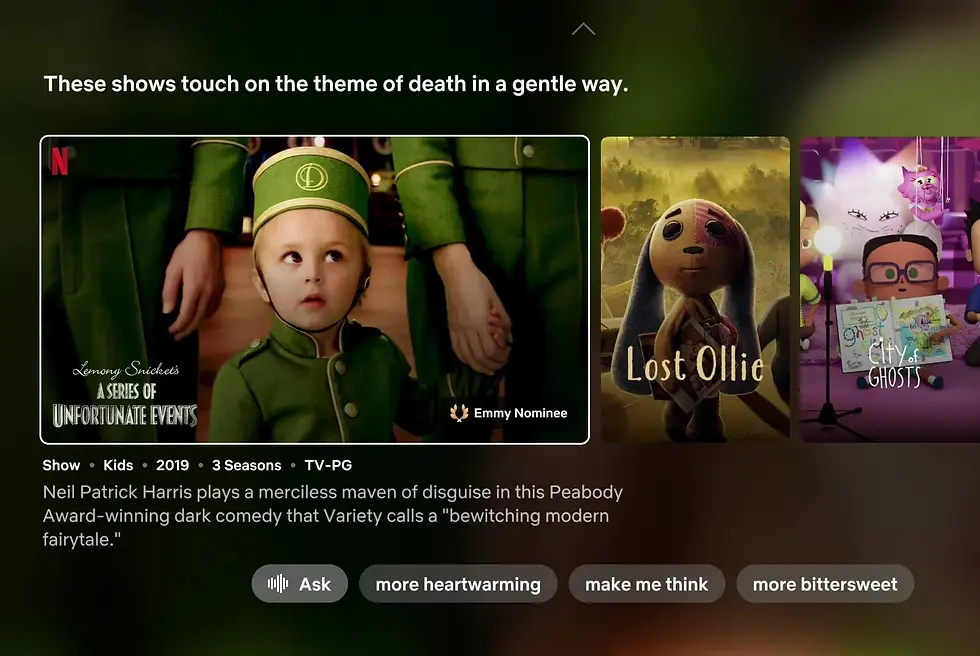
Netflix expects AI to understand viewers' needs and moods from time to time to provide more personalized suggestions
However, some industry experts warn that AI deployment could inadvertently exacerbate the underlying issue of choice paralysis. If these new models continue to be trained on the same datasets and optimized primarily for maximizing total watch time, the AI will likely prioritize narrative formulas that have already proven highly successful with mainstream audiences. Consequently, safe, familiar content will continue to be pushed to the forefront, while niche, auteur-driven, or experimental works face even steeper barriers in reaching a viewer.
Furthermore, the utility of AI in the entertainment sector extends far beyond content recommendations. Many major studios and streaming platforms are already deploying generative tools to create promotional imagery, customize trailers, analyze scripts, and forecast viewer reception before a project is ever greenlit.
For Netflix, AI promises to provide a critical liferaft to help users navigate a vast ocean of content more rapidly. Yet, for skeptics, the pivotal question remains whether this technology will be used to foster superior, more creative filmmaking, or if it will simply accelerate the homogenization of content. Should the latter scenario unfold, AI will fail to resolve the viewer's choice crisis; instead, it will merely guide users toward interchangeable content at a faster pace.


Comments